ParkingStudy / RFP scope guide
Parking Study RFP Data Requirements: A Scope Worksheet Before You Quote
By Northline ParkingStudy, Northline Data Systems. Prepared September 8, 2026.
To scope the data work in a parking study RFP, extract the required geography, observation periods, measures and deliverable formats from the official packet. Then assign each task to the lead consultant, field team or footage-review provider. A count of occupied spaces cannot, by itself, answer every request for turnover, duration, accessibility or parking-policy recommendations.
Use the free ParkingStudy RFP collector to find a source packet. The collector separates solicitation listings from awarded and planned project signals, but offers bounded coverage. Read the issuer's current documents and amendments before relying on a listing or pricing work.
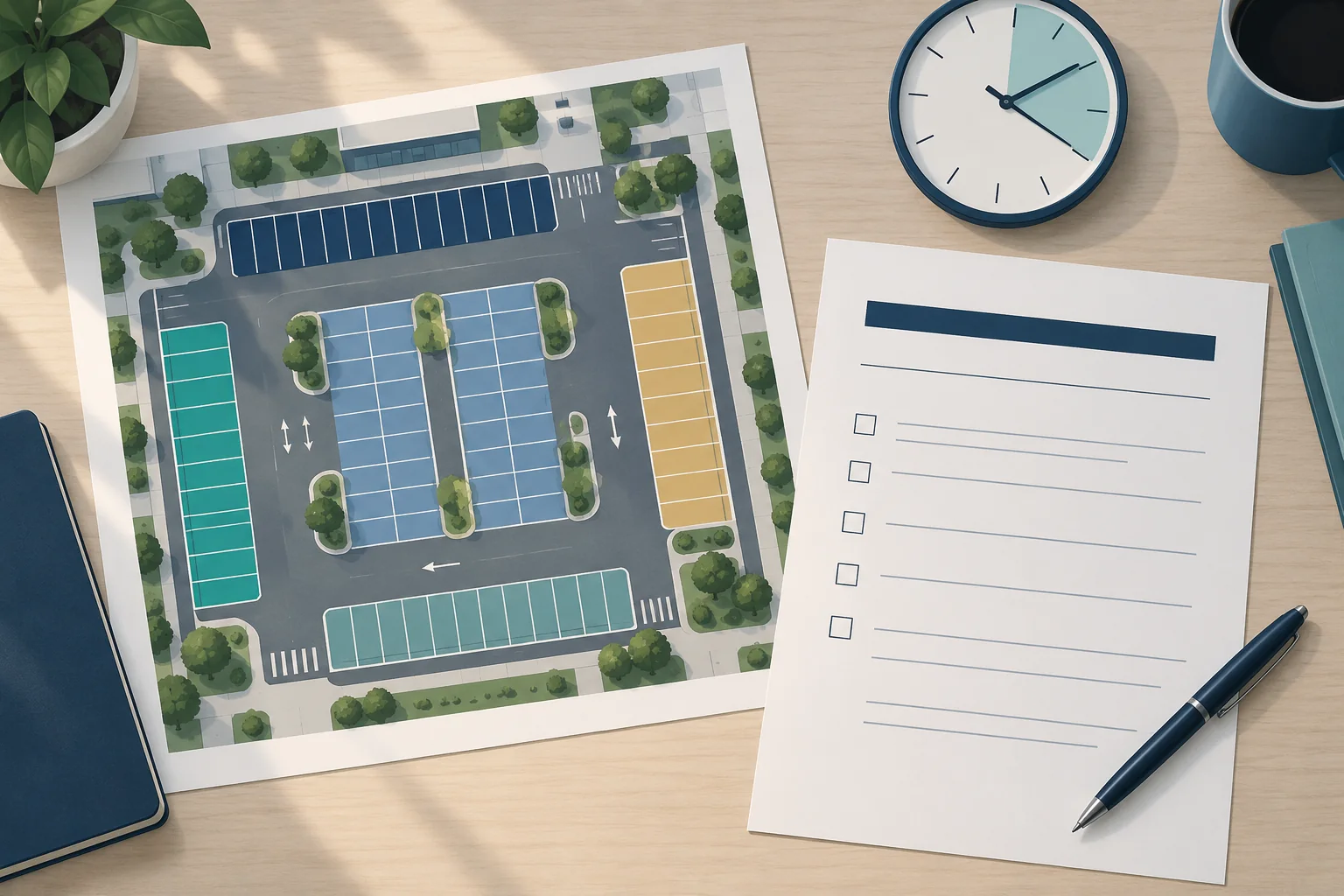
What does a real parking-study packet ask you to measure?
The City of Los Banos' Downtown Parking Management Plan RFP is a useful worked example. Its scope calls for on-street and off-street inventory, peak and off-peak utilization and turnover studies, and findings that include supply, occupied and available spaces, peak and average occupancy, turnover, duration of stay, and block-by-block or facility-level utilization as appropriate (pages 3-4).
The same packet asks for GIS-compatible inventory data and a full planning effort, including accessibility evaluation, stakeholder engagement and recommendations. Those requirements extend beyond reviewing parking footage. A team considering a narrow counting assignment should identify exactly which part of the consultant's work it can support.
Source check: retrieved September 8, 2026. The packet states a proposal deadline of October 2, 2026 at 4:00 p.m. and requires sealed submissions; it does not accept email or fax proposals (pages 1-2). Confirm the issuer's local time, latest instructions and amendments. This example does not establish that no amendment exists, that a team qualifies, or that a subcontract is available.
Build a scope worksheet before estimating review hours
Record the packet page or section beside each requirement. Keep unanswered questions visible until the lead consultant or issuer resolves them. The questions below are a proposed working method, not additional Los Banos requirements.
| Packet requirement | Question to resolve before quoting | Document in the handoff |
|---|---|---|
| Parking inventory and study boundary | Which blocks, facilities and public or private areas are included? Who confirms capacity and access? | Zone map, space inventory, exclusions and responsibility for field access. |
| Peak and off-peak utilization | Which dates and time windows represent the requested conditions? Are events or different day types needed? | Observation plan, time zone, count interval and occupied/available-space definitions. |
| Turnover and duration | Can the agreed method detect a departure and replacement between observations? | Observation limits, change-detection method and rules for incomplete stays. |
| Block or facility findings and GIS data | Can the count locations match the lead consultant's map and output specification? | Stable location identifiers, coordinate requirements, table fields and file formats. |
| Accessibility, engagement and recommendations | Who owns professional evaluation, stakeholder work and final recommendations? | Named lead responsibilities and an explicit boundary around count support. |
Keep occupancy, turnover and duration separate
Occupancy records how many spaces are occupied at an observation time. Turnover concerns changes in occupancy, while duration concerns how long an observed stay lasts. If a space is occupied in two sampled frames, that alone does not prove the same vehicle remained between them. A departure and replacement can occur outside the sampled moments.
For footage that starts or ends during a stay, report only the supported observation window. Do not turn an incomplete observation into an exact arrival, departure or full-stay duration. Agree on the method before committing to duration findings. The fixed-camera turnover and dwell guide explains these limits in more detail.
Separate field collection from footage review
An RFP requiring parking observations does not establish that useful camera footage already exists. Ask who will lawfully collect or supply the observations, whether the views cover the required spaces, and whether timestamps and observation windows match the scope. A remote review cannot replace missing coverage of an unseen block.
Northline ParkingStudy reviews authorized fixed-camera footage for scoped parking-utilization findings and supporting exhibits. Discuss the property, decision, windows and footage source first. Agree on authorization and a secure transfer method before sending a sample or full export. A usable view for occupancy may still be unsuitable for turnover or another requested measure.
The lead consultant retains study design, professional interpretation, code analysis and client or agency submissions. Northline does not provide live monitoring, vehicle or person identification, individual tracking or an engineering opinion. See the engineering subcontract-support guide for the division of responsibilities.
Use the collector, then bring a defined data question
Start with the official opportunity record and extract the data requirements. If your team needs help reviewing authorized footage, discuss the parking-study scope and camera view with Northline. Bring the relevant packet sections and intended observations, rather than sending footage before the scope conversation.
Research and scope guidance, not legal or procurement advice. Northline is independent of the named issuer. The source example does not imply an award, client relationship, confirmed subcontract need or permission to process footage. Recheck time-sensitive source details before publication and use.