
See how full your parking lot really gets.
Send us video from the cameras you already have. We count the parked cars hour by hour and send back a simple report showing your busiest times.
From $495 per study · $15 per hour of video, per camera
How it works
Send us your footage
Video from cameras you already have. We agree a safe way to share it first.
We count the spaces
We count how many spaces are taken, hour by hour. Nobody has to stand in your lot.
You get the report
A short report and a spreadsheet that show your busiest times.
What we count
How full your lot gets
How many spaces are taken, hour by hour, and when your lot is busiest.
From $495 per study
See what you get backTraffic counts
How many vehicles pass a street or entrance, and which way they turn, counted from video you already have.
$15 per hour of video, per camera
Read about traffic countsLoading zones and curbs
How often a loading zone or curb space is in use, and its busiest times.
Priced separately, after a test on your video
Read about loading and curb counts
What you get back
- How many spaces were taken, hour by hour
- Your busiest times, by day and by area
- A short report and a spreadsheet you can share
- A clear note on anything the cameras couldn’t see
Who it’s for
Parking lot and garage owners, property managers, campuses, hospitals, event venues, and the engineering and planning firms that run parking studies for them.
Pricing
From $495 per study. $15 per hour of video, per camera.
Traffic counts are also $15 per hour of video, per camera. You get a fixed price in writing before any work starts. See the full pricing details.
Only if you already have a written quote from Northline. Enter the amount on your quote at checkout. No quote yet? Get one first.
We only use video you’re allowed to share.
No new cameras, no live watching, no reading number plates, and no tracking of people.
For engineers, planners and anyone who wants the method, accuracy checks, pricing math and file formats.
How it works: technical details
Pricing details
A footage-hour is one hour of video from one camera view. Send a short project description and we confirm footage-hours, outputs and price in a fixed written quote before work starts.
| Work | Rate | Minimum |
|---|---|---|
| Parking utilization study | $15 per footage-hour | $495 per study |
| White-label count batch for firms | $15 per footage-hour | $150 per batch |
| Traffic counts | $15 per footage-hour | Confirmed in your written quote |
Example: 3 camera views × 14 hours = 42 footage-hours = $630.
Typical turnaround is 5 business days after scope, authorization and footage transfer are confirmed. Pricing doesn’t include a full engineering study or field collection.
What’s in the files
- An editable spreadsheet
Observations by timestamp and agreed area. Agree the columns with us before counting starts.
- Utilization and peak periods
Summaries for the visible, agreed capacity, by time and zone.
- A PDF report
What was observed and what limits apply, with permitted supporting images where they help.
- Gap notes
Intervals or areas that couldn’t support a reliable observation, and why.
This covers fixed-camera parking utilization and traffic counts, both at $15 per footage-hour. Loading activity and duration questions need their own feasibility check and scope. Duration here means the minimum time a vehicle was seen in the available footage, not a guaranteed full stay or tracking of individuals.
Question first, footage later
- Request a screenshot check
Tell us what your study needs to answer. We reply by email and arrange a secure way to share one permitted, representative screenshot.
- We check the view
We look at whether that view can support the work before quoting. Leave out or blur faces and plates you don’t need.
- Agree the handoff
Footage permission, areas, observation windows, spreadsheet format, limits, fixed fee and delivery date are all settled before counting starts.
How each camera view is checked
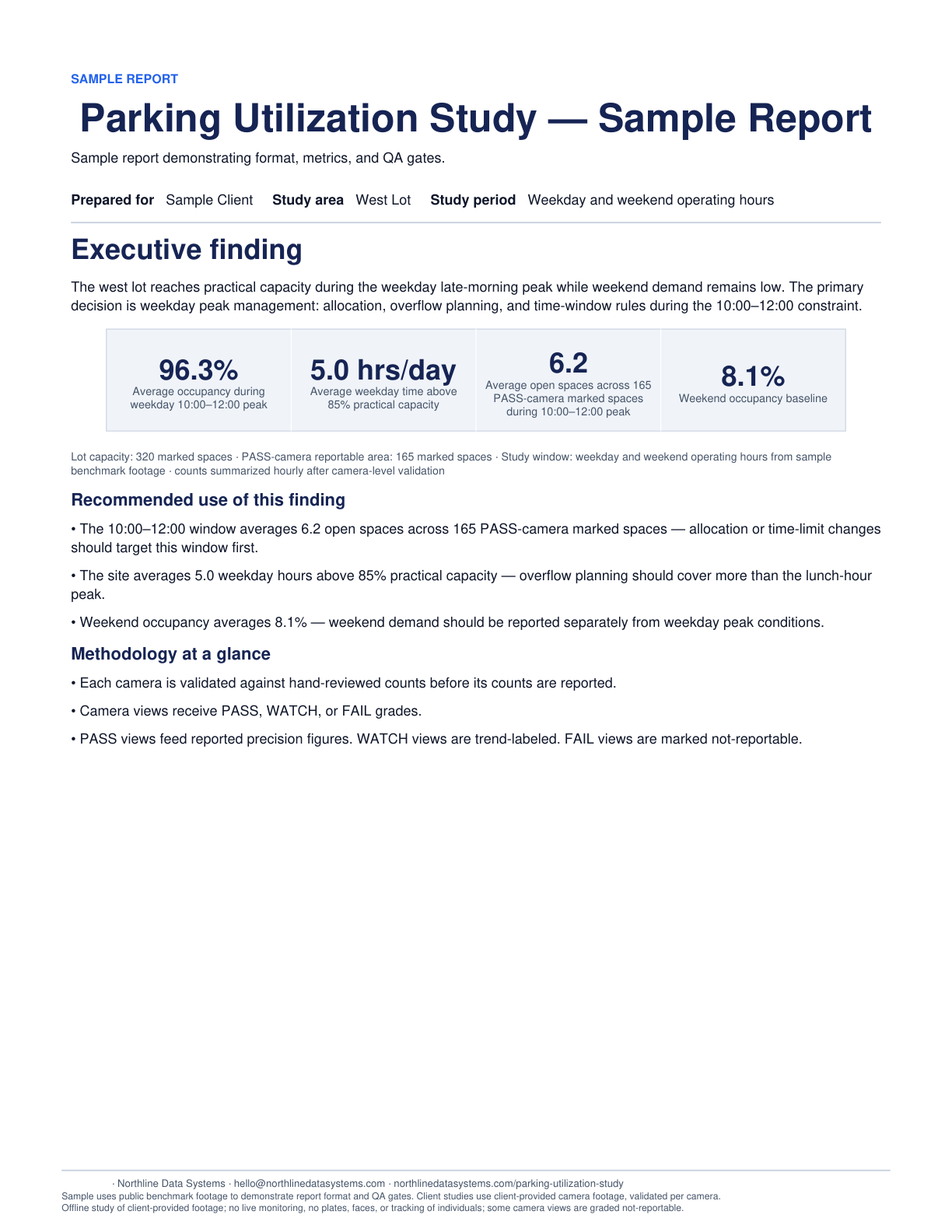
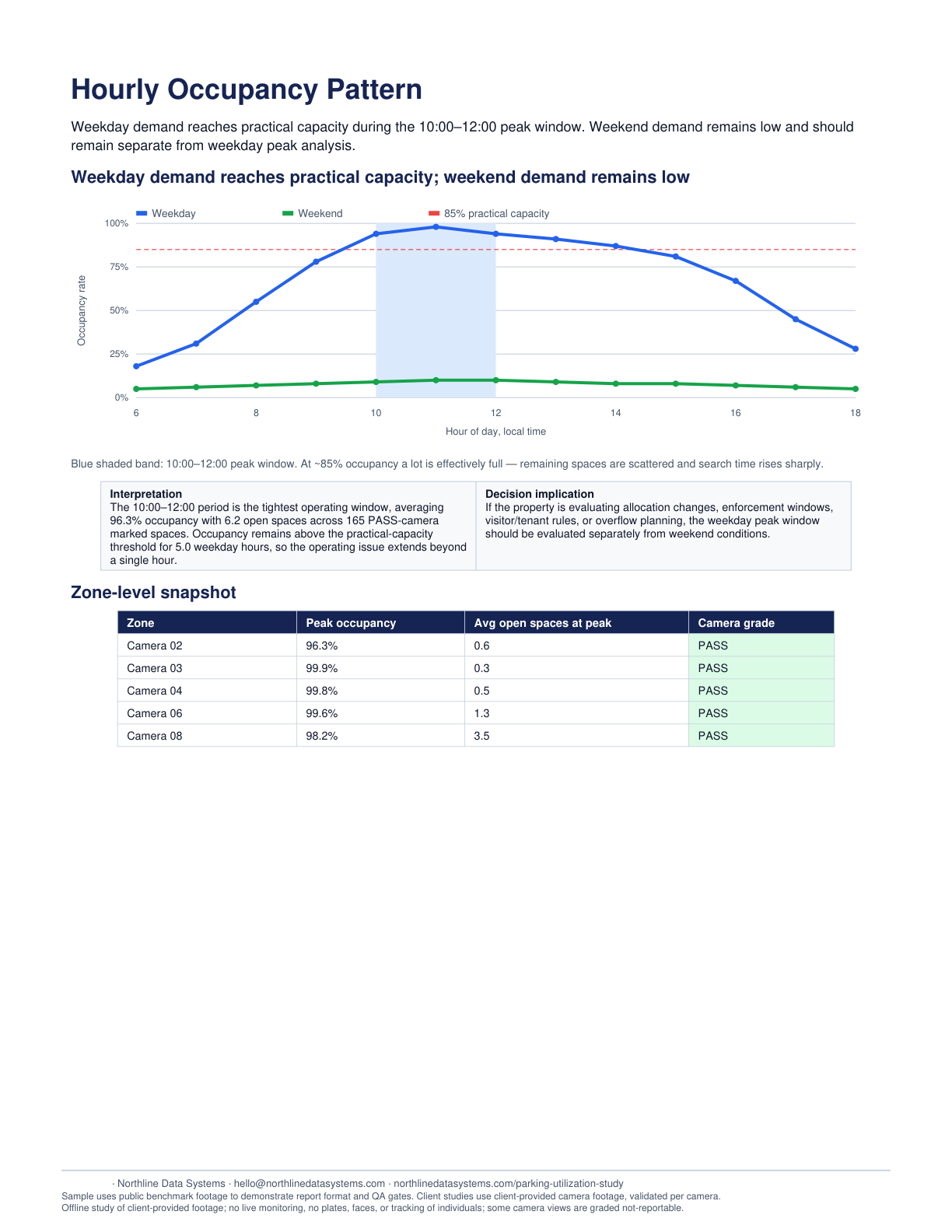
The sample report is built from public benchmark footage, not a customer site. It separates the weekday 10:00–12:00 peak from weekend demand, charts occupancy by hour, and grades each camera view against a hand count. Its figures describe that sample only and aren’t an accuracy promise for your site.
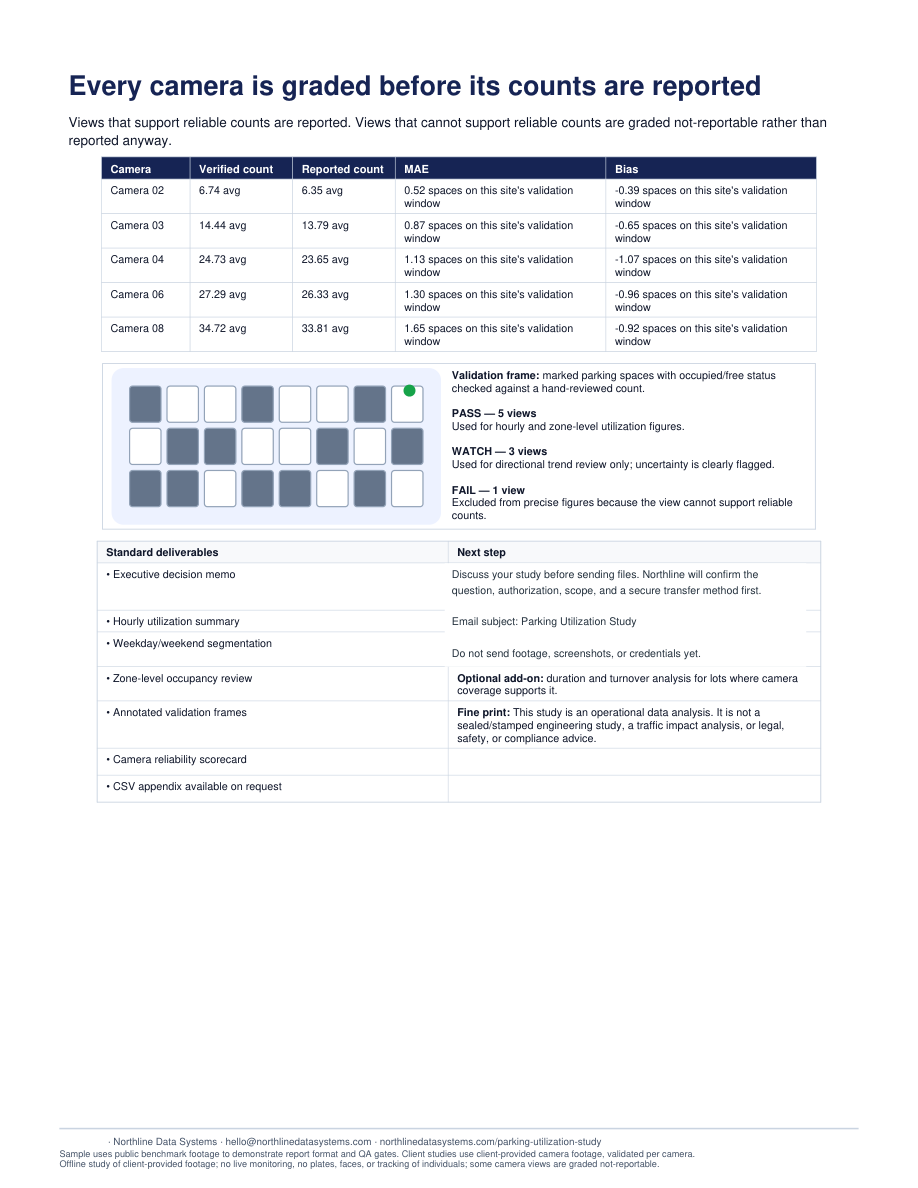
| Camera | Hand count | Reported | Mean error | Grade |
|---|---|---|---|---|
| Camera 02 | 6.74 | 6.35 | 0.52 | PASS |
| Camera 03 | 14.44 | 13.79 | 0.87 | PASS |
| Camera 04 | 24.73 | 23.65 | 1.13 | PASS |
| Camera 06 | 27.29 | 26.33 | 1.30 | PASS |
| Camera 08 | 34.72 | 33.81 | 1.65 | PASS |
Excerpt from the sample report, page 3. Public benchmark footage, not a client site. Counts are average occupied spaces over that site's validation window; mean error is in spaces.
A weak view gets a straight answer
- PASS
Measured validation supports decision-grade reporting for that zone.
- WATCH
Measured validation supports directional use, with the cautions stated.
- FAIL
Measured validation doesn’t support count-based recommendations for that zone.
- Study boundary
We analyze spaces and zones. Field capture, engineering conclusions, identity or plate recognition, enforcement and continuous monitoring are not part of this service.
- Data handling
Don’t send footage, screenshots, NVR passwords or credentials until we’ve confirmed scope and a secure transfer method.
For engineering and planning firms
Your team keeps the study
We do the hours of watching footage and recording counts. Your firm keeps study design, interpretation, recommendations and the client relationship. We supply the agreed data and supporting exhibits, not engineering or a stamped report.
Footage you’re allowed to use
Footage can come from your staff, a field partner or your client, as long as it’s authorized.
Unbranded count batches for your deliverables
We return occupancy count tables and supporting frames without Northline branding, in the column layout your team sets, for your staff to review and issue.
$15 per footage-hour, $150 minimum per batch. Larger batches are confirmed in a written quote first. No identity tracking, facial recognition or license-plate recognition. Traffic counts are also $15 per footage-hour.
Smaller pieces of a study
- Finish a study’s count tables
Send the spreadsheet layout you need, the observation windows, and the authorized footage once transfer is agreed. We assess the view and agree the exact tables and report material before work begins.
- Explain differences between count sources
Share the records you’re permitted to share and the question. Gate entries, payment transactions and concurrent occupancy measure different things, so we compare recording windows and definitions first. We won’t force the numbers to agree or infer full-day occupancy the data doesn’t support.
Planning a study or answering an RFP?
Use the parking RFP opportunities page to read source packets, then bring the required counts, coverage and deliverables to a study conversation. Listings are research leads, not a promise that a bid is current or a fit.
- Scope worksheet (CSV)Blank planning sheet: study question, areas, observation windows, known capacity, outputs.
- Scope worksheet (XLSX)The same fields as a spreadsheet. No client data in it.
- Parking RFP opportunitiesCurrent parking and traffic opportunities by status, deadline, source and scope. Free: get the list by email.
- Camera-view check before the parking studyThe checklist to run before a scope conversation. Send a sample only after permission and a secure transfer method are agreed.
- Parking occupancy study from existing footageWhen fixed-camera footage can support peak-use windows, hourly occupancy, zone pressure and reliability grades.
- What to check before trusting camera-based countsThe validation checks a camera-based count should pass before it goes into a memo.
- Loading-zone and curb activity from camera footageHow suitable fixed views can support loading-zone occupancy, activity windows, broad vehicle classes and bounded dwell findings.
- Subcontract support for civil and traffic engineersHow footage collected by a firm, vendor or client becomes traceable count tables, evidence frames and appendix exhibits.
- Every ParkingStudy articleThe full list.
Common questions
What is a parking utilization study?
A parking utilization study measures occupied spaces against known visible capacity over selected observation windows. Northline reviews authorized fixed-camera footage for occupancy by time and area, peak periods, and supporting observations.
Can Northline work as a subcontractor to our engineering or planning firm?
Yes. Northline can take on scoped parking counts and video review, returning CSV count tables, utilization charts, timestamped supporting frames, and an exception log. Your firm retains study design, professional interpretation, recommendations, and client or agency submissions.
What information is needed for a quote?
Request a screenshot check with the question your study needs to answer. We arrange secure sharing of one permitted, representative image before quoting. Omit or obscure unnecessary faces and plates. Then confirm the site and zones, known capacity, observation dates and timezone, required count interval, footage source, requested outputs, and deadline. Northline confirms a narrow written scope, feasibility, price, and delivery timing before work begins. Do not send footage or screenshots until authorization and a secure transfer method are agreed.
How much does a parking study cost?
Pricing is $15 per footage-hour (one hour of video from one camera view), with a $495 minimum per study. For example, three camera views for 14 hours each is 42 footage-hours, or $630. A fixed written quote confirms footage-hours, outputs, and delivery timing before work starts. Pricing does not include a full engineering study or field collection. Traffic counts are also $15 per footage-hour.
Do you offer white-label count support for firms?
Yes. Engineering and planning firms can order unbranded parking count batches at $15 per footage-hour with a $150 minimum per batch. You receive count tables and supporting frames in your agreed layout; your firm keeps study design, interpretation, and the client relationship. No identity tracking, facial recognition, or license-plate recognition.
How is camera suitability different from count validation?
After scope and secure transfer are agreed, an authorized sample is checked for visibility, timestamps, lighting, occlusion, and camera stability. A usable view is not an accuracy guarantee. PASS, WATCH, or FAIL is assigned by zone only after independent hand-label validation; insufficient labels remain ungraded.
Does the service include traffic engineering, identification, or enforcement?
No. This is offline parking data support, not engineering judgment, design, an agency approval, live monitoring, plate reading, identity tracking, or enforcement. Curb and loading review must be separately scoped; duration describes minimum observed presence within the available footage, not a guaranteed full stay.
How long does a parking study take?
Typical turnaround is 5 business days after scope, authorization, and footage transfer are confirmed.
Want to know how full your lot gets?
Send us your email and we’ll take it from there.